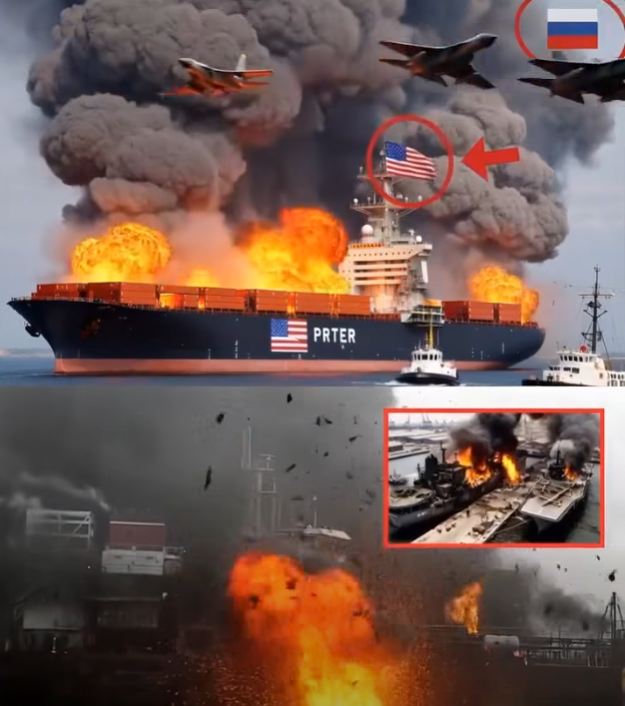
Just two hours ago, reports began circulating across maritime communication networks, military discussion forums, and social media platforms about the mysterious disappearance of a cargo vessel reportedly connected to the transport of military personnel. The sudden loss of contact with the ship immediately triggered concern among maritime authorities and fueled intense speculation online.
What initially appeared to be a routine maritime emergency quickly evolved into a much larger mystery.
Questions emerged almost immediately.
How could a vessel operating under modern navigation systems suddenly vanish?
Why did communication reportedly cease without warning?
And perhaps most importantly, what exactly happened during the final moments before contact was lost?
As information continues to emerge, authorities are urging caution and emphasizing that many details remain unconfirmed. Nevertheless, the incident has already attracted widespread attention because of the unusual circumstances surrounding the vessel’s disappearance.
According to preliminary reports, the ship had been operating along a regularly monitored route when communication systems reportedly stopped transmitting. Maritime monitoring centers allegedly noticed irregularities after scheduled check-ins failed to occur.
Initially, officials believed the problem might involve technical difficulties.
Communication interruptions occasionally occur at sea due to equipment malfunctions, weather conditions, or signal disruptions. Such incidents are usually resolved quickly once alternative communication methods are established.
This time, however, the situation appeared different.
Minutes became hours.
Repeated attempts to establish contact reportedly failed.
Tracking information became inconsistent.
And concern began spreading among maritime authorities responsible for monitoring the vessel’s route.
Search and rescue protocols were reportedly initiated shortly afterward.
Aircraft, patrol vessels, and emergency response teams were allegedly dispatched to the region where the ship was last believed to have been operating. Maritime authorities sought to determine whether the vessel had suffered mechanical failure, experienced navigational difficulties, or encountered severe environmental conditions.
The exact location of the incident has not been fully disclosed in early reports.
Officials often withhold operational details during the initial phases of maritime emergencies to avoid interfering with ongoing response efforts and investigations.
Despite the lack of confirmed information, online speculation quickly intensified.
Social media platforms became flooded with theories.
Some users suggested mechanical failure.
Others pointed toward severe weather.
A number of commentators proposed more dramatic explanations involving sabotage, hostile activity, or navigational system interference.
At present, none of these theories have been verified.
Experts caution that maritime incidents often generate rumors long before investigators have gathered sufficient evidence to establish facts.
History has shown that early reports during emergencies can be incomplete, inaccurate, or subject to significant revision as additional information becomes available.
Nevertheless, the circumstances surrounding the disappearance have generated unusual levels of interest.
One reason involves the reported connection between the vessel and military personnel transportation.
While cargo ships frequently support logistical operations worldwide, any vessel associated with military movement naturally attracts greater public attention when an incident occurs.
Military logistics networks depend heavily on maritime transportation.
Ships move personnel, equipment, supplies, and humanitarian resources across vast distances every day.
Because of this role, incidents involving such vessels often prompt heightened scrutiny and rapid responses from multiple agencies.
Maritime analysts note that modern vessels are typically equipped with numerous safety and tracking systems.
These may include satellite communications, emergency beacons, navigation systems, radar equipment, and automated identification technology.
Such systems significantly improve safety and monitoring capabilities compared to previous decades.
However, even advanced technology cannot eliminate all risks associated with operating at sea.
Oceans remain among the most challenging environments on Earth.
Vast distances, rapidly changing weather conditions, mechanical failures, navigational hazards, and communication limitations can all contribute to emergencies.
Experienced mariners often emphasize that despite technological advancements, the sea remains unpredictable.
Search operations are reportedly focusing on establishing a clearer timeline of events.
Investigators will likely examine communication records, weather data, tracking information, maintenance logs, crew reports, and other relevant evidence.
These elements help authorities reconstruct what occurred during the vessel’s final known movements.
Maritime investigations can be complex and time-consuming.
Unlike incidents that occur on land, evidence at sea may be difficult to access or recover.
Weather conditions, ocean currents, and environmental factors can significantly complicate recovery efforts.
As a result, investigators often require substantial time before reaching reliable conclusions.
Meanwhile, concern continues growing among families and communities connected to those who may have been aboard.
Whenever communication with a vessel is lost, uncertainty becomes one of the most difficult challenges faced by loved ones.
The absence of information can be emotionally overwhelming.
Authorities typically prioritize communication with families while simultaneously conducting search operations and collecting evidence.
Psychologists who study crisis situations note that uncertainty often fuels speculation.
When people lack information, they naturally attempt to fill gaps with assumptions, theories, and interpretations.
This phenomenon is particularly visible during high-profile incidents that attract intense public interest.
For this reason, officials continue encouraging patience and caution regarding unverified reports.
Several maritime experts have also urged observers to avoid drawing conclusions prematurely.
While dramatic explanations frequently dominate online discussions, many maritime incidents ultimately result from combinations of ordinary factors such as weather, mechanical issues, human error, or communication failures.
Determining the actual cause requires evidence rather than speculation.
As rescue and investigative efforts continue, authorities remain focused on locating the vessel, establishing the facts, and ensuring the safety of any individuals potentially affected.
The coming hours and days will likely provide greater clarity regarding the circumstances surrounding the disappearance.
Until then, much remains unknown.
What began as a routine voyage has evolved into a developing maritime mystery that has captured international attention. The combination of the vessel’s reported military connection, the sudden loss of communication, and the absence of immediate explanations has fueled widespread concern and intense interest.
Yet amid the speculation, one reality remains clear.
The priority for authorities is not the rumors circulating online, but the search for verified answers.
Whether the incident ultimately proves to be the result of technical difficulties, environmental conditions, operational challenges, or some other factor entirely, investigators will rely on evidence to reconstruct what happened.
For now, maritime agencies, military officials, emergency responders, and concerned observers around the world continue watching closely, awaiting confirmed information about a vessel whose sudden disappearance has left far more questions than answers.
As developments emerge, authorities are expected to provide additional updates. Until then, the story remains an unfolding investigation—one that highlights both the power of modern technology and the enduring uncertainties that can still exist upon the world’s oceans.
