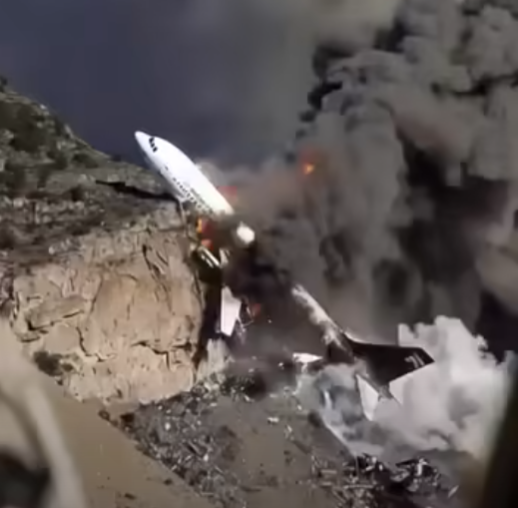
A major emergency response is reportedly underway after a passenger aircraft allegedly crashed near a remote mountain range earlier today, triggering widespread fear and confusion as rescue teams raced toward the scene. Early reports suggest the aircraft lost contact with air traffic control shortly before disappearing from radar, prompting immediate concern among aviation authorities and emergency agencies monitoring the flight’s route.
According to preliminary information circulating through local media and emergency channels, the aircraft was believed to be carrying dozens of passengers and crew members at the time of the incident. Officials have not yet released confirmed numbers regarding those onboard, and many details remain unclear as rescue operations continue under extremely difficult conditions.
Witnesses living in nearby communities reported hearing unusual sounds echoing through the mountains shortly before thick smoke was allegedly seen rising from a heavily forested area. Several residents described seeing emergency helicopters moving rapidly toward the region as authorities attempted to locate the wreckage and assess the situation.
Because the crash reportedly occurred in rugged and isolated terrain, rescue teams have faced significant obstacles reaching the area safely. Mountain roads, poor visibility, steep slopes, and unpredictable weather conditions have complicated the response effort, slowing the movement of emergency vehicles and specialized recovery crews.
Authorities quickly established a restricted perimeter around sections of the region while coordinating with aviation officials, firefighters, military support units, and medical responders. Search-and-rescue helicopters were deployed to scan the mountainside from above while ground teams worked carefully through difficult terrain below.
Emergency officials stated that the first priority remains locating survivors and providing immediate medical assistance wherever possible.
The developing situation has drawn intense public attention as families anxiously wait for verified updates regarding passengers believed to be onboard. Airports connected to the flight reportedly activated crisis response procedures, while airline representatives established emergency communication centers to assist relatives seeking information.
Scenes of concern and uncertainty unfolded inside airport terminals as travelers and family members gathered near information desks awaiting official confirmation. Some individuals were seen making emotional phone calls while others closely followed news broadcasts and social media updates for any sign of new developments.
Authorities have urged the public to avoid spreading unverified rumors during the ongoing emergency.
In fast-moving incidents involving aviation disasters, misinformation often spreads rapidly online, creating additional distress for families and communities already struggling with uncertainty. Officials emphasized that only confirmed updates from emergency agencies and aviation investigators should be considered reliable while the investigation continues.
Although the exact cause of the reported crash remains unknown, aviation experts note that aircraft incidents can result from multiple overlapping factors rather than a single isolated problem. Weather conditions, mechanical failures, navigation issues, pilot communication difficulties, or sudden onboard emergencies are among the many possibilities investigators may eventually examine.
Modern passenger aircraft are designed with multiple safety systems intended to reduce the likelihood of catastrophic failures. However, experts emphasize that aviation accidents, while statistically rare, can still occur under complex and unpredictable circumstances.
Investigators are expected to review several key areas once access to the crash site becomes fully possible, including:
Flight communication records
Aircraft maintenance history
Weather conditions along the route
Air traffic control data
Pilot experience and training
Possible mechanical malfunctions
Radar and navigation information
Any available witness accounts
Specialized aviation investigators will likely work alongside national transportation safety authorities to reconstruct the aircraft’s final moments as accurately as possible.
Meanwhile, hospitals in nearby regions reportedly activated emergency preparedness measures in anticipation of possible survivors being transported from the scene. Medical personnel prepared trauma units and coordinated additional staffing as emergency officials continued assessing conditions in the mountainous area.
The emotional impact of incidents like this often extends far beyond those directly involved.
Aviation disasters deeply affect families, emergency responders, airline staff, local communities, and even people watching events unfold from afar. The combination of uncertainty, fear, and incomplete information can create intense emotional strain during the critical first hours following a reported crash.
Rescue workers operating in these environments frequently face enormous psychological pressure as they navigate dangerous terrain while searching for survivors under urgent time constraints.
Mountain rescue operations are especially challenging because unstable ground, limited visibility, falling debris, and harsh weather conditions can place responders themselves at significant risk. Specialized teams trained in high-altitude rescue and disaster response are often required during incidents occurring in remote regions.
Officials have also warned curious onlookers and unauthorized drones to stay away from the area to avoid interfering with emergency aircraft and rescue operations. Airspace restrictions were reportedly placed over sections of the mountain range to ensure rescue helicopters and investigation teams can operate safely.
As news of the alleged crash spread internationally, messages of concern and support began appearing across social media platforms. Many people expressed sympathy for the families potentially affected while hoping rescue crews would locate survivors quickly.
Aviation analysts note that despite the intense attention such incidents receive, commercial air travel remains one of the safest forms of transportation in the world. Modern aircraft systems, pilot training programs, maintenance standards, and international safety regulations have dramatically reduced accident rates over recent decades.
Nevertheless, when rare disasters occur, they often leave a profound emotional impact because of the number of lives involved and the suddenness with which ordinary travel can turn into tragedy.
For now, authorities continue focusing on rescue efforts, scene security, and gathering accurate information before releasing further official statements. Investigators caution that early reports surrounding aviation emergencies are frequently incomplete and may change significantly as more evidence becomes available.
Families connected to the flight remain caught in an agonizing period of waiting — hoping for clarity, updates, and reassurance amid rapidly developing events.
The coming hours are expected to be critical as emergency crews continue navigating the difficult mountain terrain in search of answers and possible survivors. Until then, officials are urging patience, caution, and reliance on verified information as the situation continues unfolding.
